

An English word is a unity of sound, form, and meaning; the letters that make up a word are likewise a unity of sound, form, and meaning.
The 26 letters are more fundamental and microscopic elements than words; therefore, the unified relationship of sound, form, and meaning of the 26 letters is difficult to describe in a higher-level language. To elaborate on the connotations of the letters, we need to explore things more basic than the letters themselves.
The sound of a letter is closely related to the physiological structure of the human vocal organs — the mouth, throat, lungs, etc. Although the sounds of nature are rich and diverse, the sounds that the human mouth can produce are limited. The form of a letter is closely related to the joint structure of the human hand; the physiological structure of the human hand makes certain symbols suitable for easy writing. The meaning of a letter is closely related to food, clothing, shelter, and transportation.
Since a letter is a unified whole of sound, form, and meaning, the phenomenon of pairwise mutual conversion between “sound,” “form,” and “meaning” often occurs (sound-to-meaning, meaning-to-sound, form-to-meaning, meaning-to-form, sound-to-form, form-to-sound).
The Sound of Letters
The pronunciation of the 26 letters is formed by blending the most basic vowels and consonants; correctly mastering the pronunciation of the 26 letters means mastering the pronunciation of the vast majority of phonemes.
The table below is the pronunciation table of the English letters; one can see that this annotation system is also very concise and effective in annotating the pronunciation of the letters.
Pronunciation of the 26 Letters*
| Letter | A | B | C | D | E | F | G |
|---|---|---|---|---|---|---|---|
| Pronunciation | [ā] | [bē] | [cē] | [dē] | [ē] | [ef] | [gē] |
| Letter | H | I | J | K | L | M | N |
| Pronunciation | [āch] | [ī] | [jā] | [kā] | [el] | [em] | [en] |
| Letter | O | P | Q | R | S | T | |
| Pronunciation | [ō] | [pē] | [kū] | [àr] | [es] | [tē] | |
| Letter | U | V | W | X | Y | Z | |
| Pronunciation | [ū] | [vē] | double-[ū] | [eks] | [wī] | [zē] |
The Form of Letters
The form of the 26 letters is an extremely concise set of symbols, the product of being tempered by time over a long period; although their forms are simple, they carry extremely rich connotations.
Due to the joint structure of the human right hand, writing the two symbols — the vertical line “|” and the circle “◯” — in a connected manner from left to right can be done both quickly and effortlessly; while the short dash “—” and the dot “•” can serve as prominent marks. Therefore, the 26 letters are actually combinations of these four symbols.
When writing the vertical line “|”, it is written from top to bottom; the circle “◯” has two ways of being written: one is clockwise, the other is counterclockwise.
- 𝓪: (counterclockwise) circle + short vertical
- 𝓫: long vertical + (clockwise) circle
- 𝓬: (counterclockwise) left half-circle
- 𝓭: (counterclockwise) circle + long vertical
- 𝓮: short dash + (counterclockwise) half-circle
- 𝓯: (counterclockwise) upper-left quarter circle + long vertical + short dash
- 𝓰: (counterclockwise) circle + (clockwise) lower half-circle
- 𝓱: long vertical + (clockwise) upper half-circle
- 𝓲: short vertical + dot
- 𝓳: long vertical + (clockwise) lower half-circle + dot
- 𝓴: long vertical + (counterclockwise) left half-circle
- 𝓵: long vertical
- 𝓶: (clockwise) upper half-circle + (clockwise) upper half-circle
- 𝓷: (clockwise) upper half-circle
- 𝓸: (counterclockwise) circle
- 𝓹: long vertical + (clockwise) circle
- 𝓺: (counterclockwise) circle + long vertical
- 𝓻: short vertical + (clockwise) upper-left quarter circle
- 𝓼: (counterclockwise) upper half-circle + (clockwise) lower half-circle
- 𝓽: short vertical + (clockwise) lower-left quarter circle (connected) + short dash
- 𝓾: (counterclockwise) lower half-circle + short vertical
- 𝓿: sharpened (counterclockwise) lower half-circle
- 𝔀: sharpened (counterclockwise) lower half-circle + sharpened (counterclockwise) lower half-circle
- 𝔁: (clockwise) right half-circle + (counterclockwise) left half-circle
- 𝔂: sharpened (counterclockwise) lower half-circle + (clockwise) lower half-circle
- 𝔃: upper short dash + (connected in the middle) + lower short dash
Among the lowercase letters, all five vowel letters occupy only the middle grid; the consonant letters that occupy only the middle grid are the weaker-sounding consonants, such as the nasals 𝓶, 𝓷, the fricatives 𝓼, 𝔃, and the semivowel 𝔀. The consonant letters that occupy two grids are all stronger-sounding consonants. Thus it can be seen that there is a certain connection between the form of a letter and its pronunciation.
- Vowel letters occupying the middle grid: 𝓪, 𝓮, 𝓲, 𝓸, 𝓾,
- Consonant letters occupying the middle grid: 𝓶, 𝓷, 𝓻, 𝓼, 𝔃, 𝓬, 𝔁, 𝓿, 𝔀
- Consonant letters occupying the upper and middle grids: 𝓫, 𝓭, 𝓹, 𝓺, 𝓵, 𝓱, 𝓴, 𝓽
- Consonant letters occupying the middle and lower grids: 𝓰, 𝓳, 𝔂
- Consonant letters occupying the upper, middle, and lower grids: 𝓯
Letters occupying two grids are more visually prominent; letters occupying one grid are more visually cramped.
In rapid handwriting, a vowel letter occupying one grid and a consonant letter occupying one grid are likely to be swiftly swept over in a single connected stroke, while the consonant letters occupying two grids protrude upward or downward like spikes, and are the key visual features caught in rapid reading.
To make the initial letter more prominent, capital letters were created; a capital letter is very similar to its corresponding lowercase letter, usually having been made taller, wider, larger, or sharpened, upgrading from an inconspicuous letter to the most prominent letter in the word.
- 𝓐: sharpened, made taller and larger, upgraded from one grid to two grids
- 𝓑: enlarged, with an extra right half-circle at the top
- 𝓒: form unchanged, made taller and larger, upgraded from one grid to two grids
- 𝓓: enlarged
- 𝓔: sharpened, made taller and larger, upgraded from one grid to two grids
- 𝓕: sharpened
- 𝓖: enlarged
- 𝓗: sharpened, enlarged
- 𝓘: made taller
- 𝓙: made taller
- 𝓚: form unchanged, enlarged
- 𝓛: widened
- 𝓜: form unchanged, sharpened, made taller and larger, upgraded from one grid to two grids
- 𝓝: sharpened, made taller and larger, upgraded from one grid to two grids
- 𝓞: form unchanged, made taller and larger, upgraded from one grid to two grids
- 𝓟: form unchanged, made taller and larger,
- 𝓠: enlarged
- 𝓡: made taller and larger, upgraded from one grid to two grids
- 𝓢: form unchanged, made taller and larger, upgraded from one grid to two grids
- 𝓣: made taller and larger
- 𝓤: form unchanged, made taller and larger, upgraded from one grid to two grids
- 𝓥: form unchanged, made taller and larger, upgraded from one grid to two grids
- 𝓦: form unchanged, made taller and larger, upgraded from one grid to two grids
- 𝓧: form unchanged, made taller and larger, upgraded from one grid to two grids
- 𝓨: enlarged
- 𝓩: form unchanged, made taller and larger, upgraded from one grid to two grids
The Meaning of Letters
Since the form and sound of English letters are closely related, combining the letter form and pronunciation together with phonemes, one can appreciate the inner meaning. This subsection is content to be “intuitively grasped” and should not be treated as a general rule.
-
𝓐, 𝓪: being the first of the 26 letters, it carries the meaning of “first.” From the form of A, it resembles an arrowhead, very sharp, like the Eiffel Tower, symbolizing masculinity.
-
𝓑, 𝓫: a closed-stop (plosive) sound; when pronounced, a strong burst of air rushes out of the mouth, giving a sense of wanting to break through obstruction, throw off constraint, expand, and blow. The form of B resembles a large, stable object; B is the second letter of the alphabet and can sometimes represent “second.”
-
𝓒, 𝓬: in form it resembles a hollowed-out cave that can hide or cover; it also resembles a coiled rope, giving a sense of circulation. When this rope is tied into a hard knot, it is pronounced [k], full of dynamism; when the rope is laid casually, it is pronounced [s].
-
𝓓, 𝓭: whether in pronunciation or in form, it gives a heavy feeling, with a sense of emphasis.
-
𝓔, 𝓮: in form it suggests direction, eastward, outward. As a vowel, the letter E is very active, so E is the most frequently used letter.
-
𝓕, 𝓯: in form it resembles a flag fluttering in the wind; its pronunciation [f] is also like wind blowing, so it gives a sense of ceaseless energy in motion, with the meaning of “to do.” Since wind gives a sense of emptiness, it also carries the meaning of false and weak.
-
𝓖, 𝓰: resembles a helmet that can protect; it also gives a sense of being strong and good.
-
𝓗, 𝓱: in form it gives a sense of towering into the clouds, with meanings of sky, joy, and possession.
-
𝓘, 𝓲: represents the self, with the meaning of inward, toward the inside.
-
𝓙, 𝓳: resembles an iron hook, with the meaning of joining and connecting; the pronunciation of J represents joy.
-
𝓚, 𝓴: its pronunciation resembles the sound of snapping a branch; in form it resembles a stake and a knot.
-
𝓛, 𝓵: resembles a line, with the meaning of pulling and connecting
-
𝓜, 𝓶: in form it is very stable, like rolling hills; the pronunciation of M carries the meaning of mother and female, symbolizing feminine beauty.
-
𝓝, 𝓷: in form it resembles a door; when the door is closed, it carries the meaning of “negation”; a door also has the meaning of “connection, linking.”
-
𝓞, 𝓸: in form it is round; when pronounced, the mouth shape is also round; its meaning is also related to roundness.
-
𝓟, 𝓹: a plosive sound; when pronounced, a strong burst of air is emitted from the mouth, giving a sense of pushing force. The form of P resembles a paddle with a handle.
-
𝓠, 𝓺: a very strange letter; it must be used in combination with U and has no unique pronunciation of its own. Precisely because it is strange, it is sometimes specially favored. The form of Q resembles a swan resting on a lake, giving a very calm and peaceful feeling.
-
𝓡, 𝓻: pronounced with a retroflex curl; its pronunciation is very distinctive and harsh, with meanings of friction, beginning, and emission.
-
𝓢, 𝓼: in both form and pronunciation it resembles a snake, so the letter S, like a snake, carries rich connotations — both sacred and dark, both continuous and winding.
-
𝓣, 𝓽: in form it resembles a simplified “cross,” with meanings of mark and suffering.
-
𝓤, 𝓾: in form it resembles a cup or a ravine, with meanings of down, low, and inferior.
-
𝓥, 𝓿: in both form and pronunciation it gives a sense of speed, as fast as light, without burden; it also resembles a spinning top, with the meaning of rotation.
-
𝓦, 𝔀: in form it resembles the shape of waves, full of dynamism, with meanings of rocking, swinging, and moving. The pronunciation of W is very similar to that of U, so W corresponds to U. In form, W is a combination of uu and vv, read as “double u.”
-
𝓧, 𝔁: in shape it is a crossed cross; both its pronunciation and form are products of the combination of two things, full of mystery, and a synonym for the unknown. Because the letter x often appears in the prefix ex-, ex- is sometimes abbreviated as x.
-
𝓨, 𝔂: in form it resembles a forked tree; since the letter y corresponds to the letter i, y exists more often as a substitute for i.
-
𝓩, 𝔃: in form it resembles a bolt of lightning or a stripe, representing passion. A large number of [z] sounds are written as s; the letter Z is both the last letter and one of the least frequently used, which makes Z seem out of place in English, and words containing Z all look like foreigners.
The Sound-Form-Meaning Relationship of Letters
The letters of English are not isolated from one another; they are strongly connected. Although different letters are pronounced differently, their vocal organs are the same. Similar consonant letters are similar not only in pronunciation but also in form, so it is only natural that “sounds correspond, meanings follow” among them.
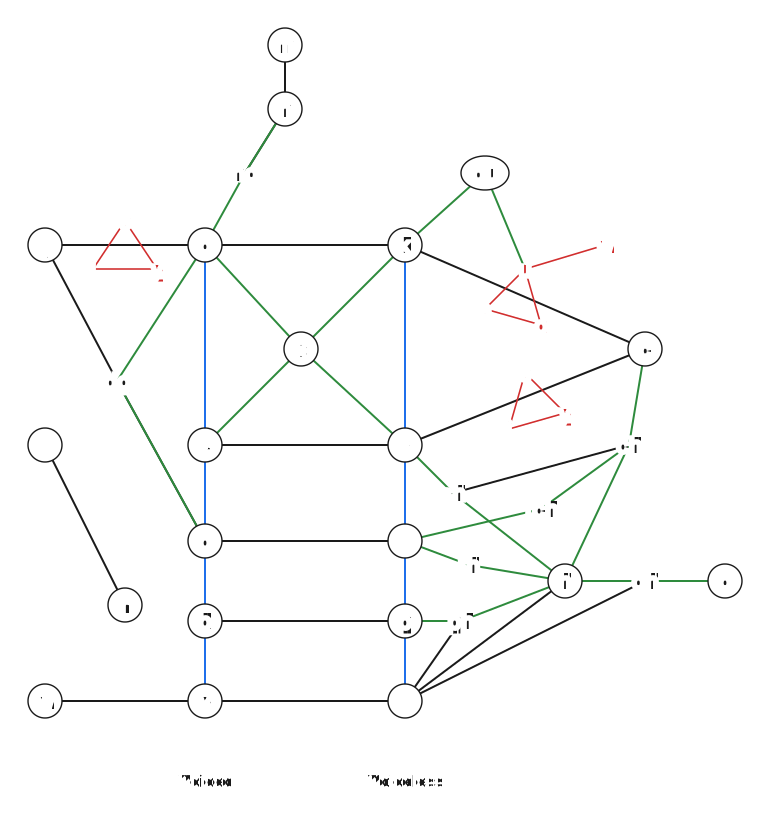
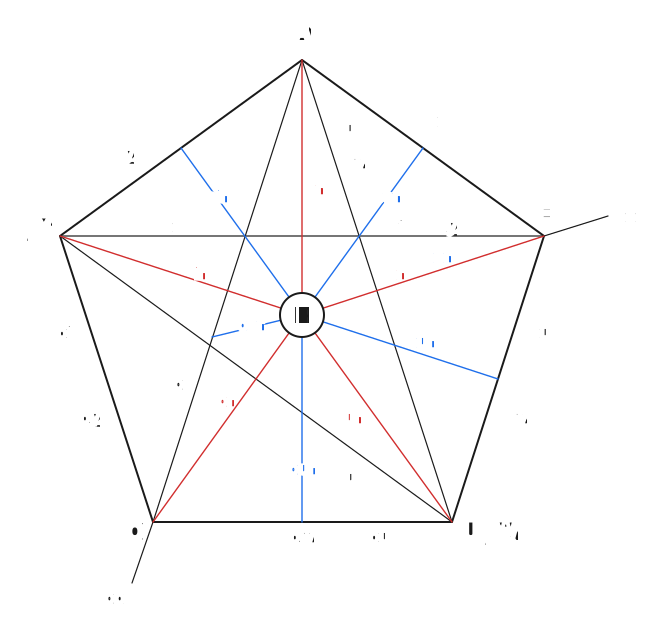
From the consonant letter relationship diagram and the vowel letter relationship diagram, we can clearly see that English words are not random combinations of letters; there is a very close connection between the letters of a word.
Sound-Form-Meaning Relationship of Consonant Letters
Figure 3. Consonant letter relationship diagram
-
b and p are both stops, one voiced and one voiceless; their forms are similar, and both carry the meaning of “a powerful force.”
-
d and t are both stops, one voiced and one voiceless; d indicates emphasis, t indicates marking, with similar meanings.
-
v and f are both fricatives, one voiced and one voiceless; v indicates speed, f indicates wind.
-
f and h are both fricatives with similar pronunciation, so people in some regions cannot distinguish f and h.
-
m and n are both nasals; their forms are similar and their pronunciations are similar.
-
r and l are both liquids; they can form double consonants with other consonants. For simplicity, the diagram does not draw their relationship lines with consonant letters; their connections can be seen in the consonant combination table.
-
g and j: g is pronounced as j before e, i, y; the two are also rather similar in form.
-
The crossed shape of the letter x exactly fits the meaning of a combination of two letters. x can be pronounced as ks or gz.
-
c and s: when c is followed by e, i, y, c is pronounced as s.
-
c and k: when c is followed by a, o, u, c is pronounced as k.
-
w and v: w and v are similar in pronunciation; in form, w is a combination of vv.
-
u and w: w corresponds to u, and w often plays the role of u.
-
z and s: s is often pronounced as z.
-
i and y: y corresponds to i, and y often plays the role of i.
-
a and o: from the vowel table, the letter a is often pronounced as the letter o, as in war, law, etc.
-
o and u: from the vowel table, the letter o is often pronounced as the letter u, as in come, love, company, etc.
-
f and gh: a small number of gh are pronounced as f, as in tough, laugh, etc.
-
ch and sh: ch is sometimes pronounced as sh, as in machine, etc.
Sound-Form-Meaning Relationship of Vowel Letters
Figure 4 shows the vowel letter relationship diagram. Many of the letters or letter combinations in the diagram have more than one pronunciation; their specific pronunciation cases have been listed in vowel table 9, so their relationships are not explained further here.
Figure 4. Vowel letter relationship diagram
Word Meaning and the Translation of Words
Every language has its own sound, form, and meaning; it is a self-contained system that does not need to rely on other languages for explanation. Different languages are both connected and unconnected.
When memorizing English words, we should try to understand the word from its literal form and context, and not impose a translated meaning onto the word.
English emphasizes the unity of sound and meaning, with meaning mainly expressed through sound; whereas Chinese emphasizes the unity of form and meaning, with meaning mainly expressed through the written form. The substance of language is sound and written form, and the conversion of substance inevitably leads to deviation in meaning.
The “meaning” of a language depends on its own “form” and “sound” to exist; separated from the original “form” and “sound,” the meaning cannot be preserved. Therefore, when we learn English, the meaning in our native language can only exist as an aid to help us appreciate the English meaning; language is difficult to translate completely.
Grasping Meaning from Spelling
The meaning of a word can be deconstructed from multiple levels — letters, phonemes, syllables, morphemes, and context. Approaching from multiple aspects, going deeper layer by layer, dismantling step by step, and finally synthesizing multiple aspects gives the most complete and correct meaning of the word.
The “grasping meaning from spelling” discussed in this book does not mean accurately stating the translated meaning of the word, but rather the literal vague meaning of the word. It is especially applicable to words that conform to word-formation rules. This vague meaning goes directly to the essential connotation of the word; it is a more scientific and rapid kind of meaning, applicable to learners whose native language is any language.


