

IPSM Approach (Integrated Pronunciation, Spelling and Meaning Approach) is a method for memorizing English vocabulary, comprising three aspects: Integrated Pronunciation & Spelling (IPS), Integrated Spelling & Meaning (ISM), and Integrated Pronunciation & Meaning (IPM).
By annotating phonemes and segmenting morphemes in English words, this method highlights and links together the otherwise separate pronunciation, spelling, and meaning of each word. As learners study, they gradually master the word’s pronunciation rules and the meaning of its core letters, achieving the ability to read sound from spelling and grasp meaning from spelling — improving the effectiveness of vocabulary memorization.
Memorizing an English word is, in essence, the process of linking the word’s three attributes — pronunciation, spelling, and meaning — together.
- Integrated Pronunciation & Spelling: embeds English pronunciation rules into the word through phoneme-annotation symbols.
- Integrated Spelling & Meaning: embeds English word-formation rules into the word through morpheme segmentation.
- Integrated Pronunciation & Meaning: achieved by appreciating the inner link between the rhythm of phonemes and the actual meaning.
The Encoding Difference Between Chinese and English
As is well known, Chinese is a logographic (or morphographic) writing system, whereas English is a phonographic writing system; the two languages differ fundamentally in their encoding. For Chinese, the written form is the most crucial link in constructing meaning; for English, speech sound is the most crucial link in constructing meaning. Chinese characters revolve around the written form, English words revolve around pronunciation, and the key to memorizing each lies respectively in the written form and in pronunciation. Because Chinese students develop morphographic thinking habits from childhood and lack an English speech-sound environment, when they first learn English they tend to treat English vocabulary as random strings of characters akin to numerals and memorize them as such. Failing to correctly summarize the internal formation patterns of English words, many students forcibly bind the word’s pronunciation, part of speech, and Chinese meaning to its spelling for memorization, greatly increasing their study burden.
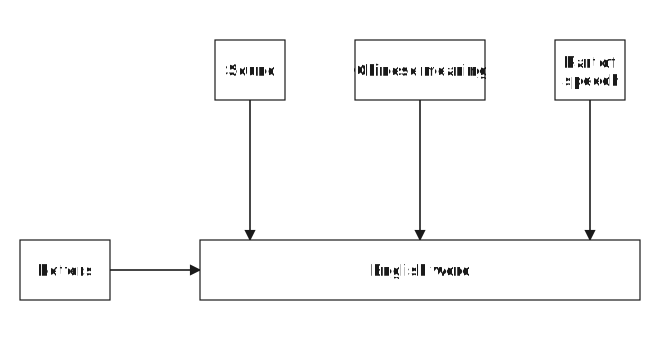
Let us first examine the most fundamental encoding process of the two languages, to explain the misconception into which English learning has fallen.
As shown in the figure, the encoding process of Chinese characters is: strokes (horizontal, vertical, left-falling, right-falling, turning) first form radicals and components; these radicals and components then form characters; and finally the characters form vocabulary.

As shown in the figure, the encoding process of English is: letters form phonemes; phonemes form morphemes; and morphemes form words.
From the comparison of logographic and phonographic writing above, we can see that the two differ greatly in the essence of their encoding. In the encoding process of a logographic script, the written form that carries meaning is the key to encoding, while pronunciation is imposed. In the encoding process of a phonographic script, pronunciation is the key to encoding, while meaning is largely imposed.

However, which parts of a word are phonemes and which are morphemes is not obvious; beginners cannot effectively distinguish them and can only memorize the whole word indiscriminately, rigidly linking the Chinese meaning, part of speech, and pronunciation to the written form.
The vast majority of English dictionaries make no segmentation of words at all; only a very few adopt “syllable division” to split words.
Compared with “syllable division,” segmentation by word-formation — “prefix + root + suffix” — is another, more reasonable and widely recognized approach. Unfortunately, although many books explain word formation, almost no English dictionary performs systematic and comprehensive morphological segmentation of words.
This gives rise to several problems: 1. Words lack a sense of hierarchy, making them hard to memorize. 2. One cannot grasp the approximate meaning and part of speech of a word from its written form. 3. The core letters and core syllables of the word are not highlighted.
Following the meaning of words, this method makes a bold segmentation: it separates out the small number of prefixes and suffixes with fixed patterns, leaving behind the root that carries the core meaning, so as to facilitate memorization.
This simple English vocabulary memorization method is easy to learn and readily fuses the sound, form, and meaning of English words together. Using this method, learners can form a correct and systematic way of thinking about words.


